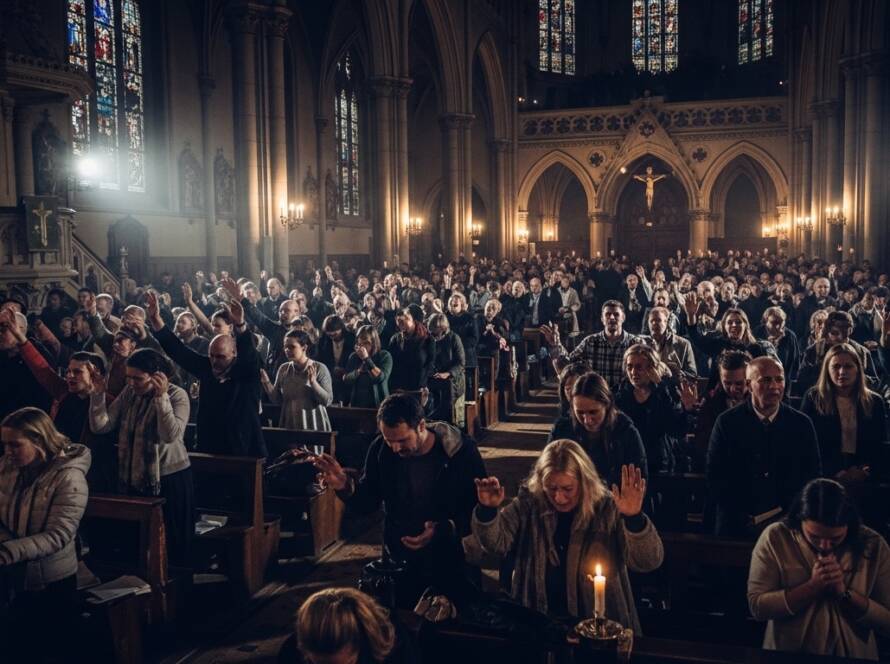
It did not begin with noise.
It began with a discomfort no one could explain.
In the early 1700s, churches were still full. Sermons were still preached.
But something was missing.
Faith had become familiar. Predictable. Almost… distant.
Then, in a small town called Northampton, a young preacher
Jonathan Edwards—stood up and began to speak.
Not loudly.
Not dramatically.
But with a weight that settled into the room.
At first, nothing unusual happened. Then slowly… hearts began to stir.
People who had sat in church their whole lives started feeling something they had never felt before—
a deep awareness of their own condition before God.
Edwards would later write that the town became filled with a strange mixture of emotions—
joy… love… and distress all at once.
Men and women who once felt secure suddenly questioned everything.
Not because they were told to, but because something inside them had awakened.
Then the fire spread.
Across towns and cities, another voice rose—
George Whitefield.
He did not stay in one place.
He moved.
Fields became pulpits. Streets became sanctuaries.
Crowds gathered in the thousands just to hear him speak.
And when he spoke…
people didn’t just listen.
They felt.
Some wept openly.
Some cried out.
Others stood still, as if struck by something unseen.
Religion was no longer routine.
It had become personal.
This was the shift.
For years, faith had lived in structures—rituals, traditions, systems.
Now it moved into the heart.
People began to see themselves differently, not as “good church members,”
but as souls in need of grace.
Preaching no longer informed, it confronted.
And those who heard it could not remain the same.
The movement spread across Britain and the American colonies,
touching churches, homes, and entire communities.
It wasn’t organized.
It wasn’t controlled.
It moved like wind
from one place to another, carrying conviction wherever it went.